Defective Shock Absorbers Prompt Safety Campaign for Toyota Tacoma Models
Toyota has announced a safety campaign affecting approximately 48,280, 2024 Toyota Tacoma Hybrid and 2024–2025 Toyota Tacoma pickup trucks after identifying a defect involving the front and rear shock absorber assemblies. According to the National Highway Traffic Safety Administration (NHTSA Campaign 26V-514), corrosion inside the shock absorbers can cause an external oil reservoir to separate from the vehicle, creating a serious hazard for other motorists.
What Is the Problem?
The affected Tacoma models are equipped with front and rear shock absorbers that use an external oil reservoir attached by a welded metal flange. Toyota determined that untreated metal surfaces hidden between the flange, reservoir, and shock absorber body can be exposed to moisture over time.
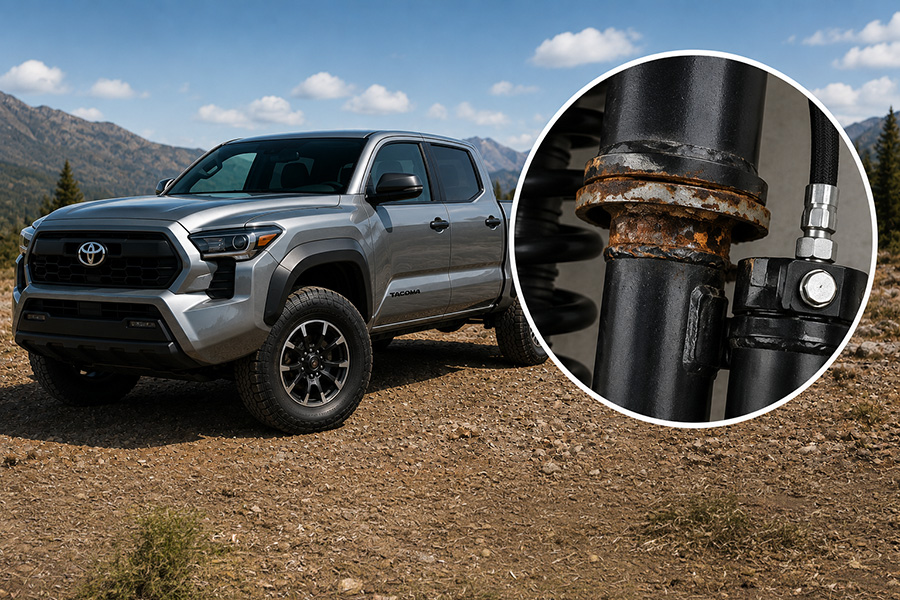
As moisture and road salt work their way into these areas, corrosion can develop beneath the protective coating. The expanding corrosion places increasing pressure on the welds that hold the reservoir in place. Eventually, those welds can fail, allowing the reservoir to detach from the shock absorber.
If the reservoir separates while the vehicle is being driven, it can become a dangerous object in the roadway, increasing the risk of a collision or injury to other road users. Drivers may also experience reduced suspension performance after the component detaches.
How Toyota Discovered the Defect
Toyota's investigation began in September 2025 after receiving reports of leaking rear shock absorbers. During an inspection, engineers found that one vehicle's left rear shock absorber had leaked and its external reservoir was already missing.
The company launched an extensive engineering investigation that included:
- Recovering failed shock absorbers from vehicles in the field.
- Dynamic driving tests to evaluate what happens if the reservoir detaches while driving.
- Laboratory corrosion testing.
- Computer simulations of weld strength.
- Dye penetration testing to determine how moisture could reach untreated metal surfaces.
Engineers eventually concluded that repeated rock impacts combined with prolonged exposure to road salt could allow corrosion to develop in areas not adequately protected. The corrosion gradually weakens the welds securing the reservoir until they can fail.
By the conclusion of its investigation, Toyota had identified 20 field technical reports and 62 warranty claims in the United States related to this condition.
What Vehicles Are Affected?
The safety campaign applies to certain:
- 2024 Toyota Tacoma Hybrid
- 2024–2025 Toyota Tacoma
Not every vehicle from these model years is affected.
What Will Toyota Do?
Toyota dealers will inspect both the front and rear shock absorber assemblies and replace the affected assemblies as necessary at no cost to owners.
Owner notification letters are expected to be mailed beginning September 21, 2026.
The campaign identifiers are:
- NHTSA Campaign Number: 26V-514
- Toyota Campaign Numbers: 26TB14 and 26TA14
What Should Owners Do?
If you own a 2024 or 2025 Toyota Tacoma or a 2024 Tacoma Hybrid, it is important to determine whether your vehicle is included in this safety campaign. Although the defect may not produce obvious symptoms before a failure occurs, leaking shock absorbers, unusual suspension performance, or visible damage around the shock absorber assemblies should be inspected promptly.
If you own a 2024 or 2025 Toyota Tacoma or a 2024 Tacoma Hybrid and receive a notification, schedule an appointment with a Toyota dealer to have the vehicle inspected and repaired as soon as possible. Addressing the defect early can help prevent suspension problems and reduce the risk of the external reservoir detaching while the vehicle is in motion.